


According to ABBYY, the latest State of Intelligent Automation: GenAI Confessions 2025 report, an overwhelming 91% of financial services organizations have adopted Generative AI, and nearly all of them are seeing measurable results.
From automating document-heavy workflows to uncovering new layers of customer insight, GenAI is redefining productivity across global banking and finance. The report, conducted across six major economies, reveals an emerging reality: AI is a strategic enabler that bridges human intelligence with machine efficiency.
Yet behind this rapid adoption lies a fascinating duality. On one hand, businesses are achieving higher output consistency, accuracy, and cost savings; on the other, employees are taking AI into their own hands, sometimes without IT oversight, a phenomenon ABBYY calls “Shadow AI.”
As financial leaders weigh opportunity against oversight, one thing is clear: the next phase of digital finance will be built on intelligent, ethical, and empowered automation. This article dives into ABBYY’s key findings to uncover how innovation, governance, and global ambition are converging to reshape the future of financial technology.
The World’s Fastest-Evolving AI Workforce
Across industries and continents, 89 percent of respondents report positive outcomes from GenAI adoption, proof that the technology has moved well beyond experimentation. The improvements are tangible: greater output consistency, enhanced accuracy, stronger user trust, and meaningful cost savings.
However, behind these numbers lies a deeper shift in workplace culture. More than half of employees admit they use GenAI to “look more professional,” while 55 percent say it lightens their workload and sparks creativity. In other words, the technology isn’t simply automating tasks; it’s elevating how people present themselves and perform at work.
This balance between performance and perception underscores a key insight from ABBYY’s findings: the success of GenAI depends as much on human curiosity as on computing power. When teams are empowered to experiment, innovation scales naturally. That dynamic has given rise to a quiet revolution known as Shadow AI, where employees introduce generative tools on their own before official rollout.
Interestingly, this bottom-up adoption often prompts leadership to act. Many organizations in the study introduced GenAI precisely because their people were already using it under Bring Your Own Software (BYOS) setups. Rather than resist, forward-thinking leaders are learning to harness that enthusiasm, building structured governance on top of spontaneous innovation.
ABBYY’s research suggests that this global workforce evolution isn’t about replacing humans with algorithms. It’s about creating synergy between analytical precision and human intuition, a partnership that’s already redefining how modern enterprises, especially financial institutions, compete and create value.
The Rise of Shadow AI: Empowerment or Exposure?
One of the most revealing findings from ABBYY’s global survey is the quiet surge of Shadow AI, a trend where employees use generative AI tools without IT approval. It’s happening everywhere, from banks and insurance firms to trading desks and customer service teams.
The numbers tell the story: 22 percent of U.S. employees, 19 percent in France, 21 percent in Germany, 17 percent in Australia, and a remarkable 26 percent in Singapore admit to adopting AI on their own.
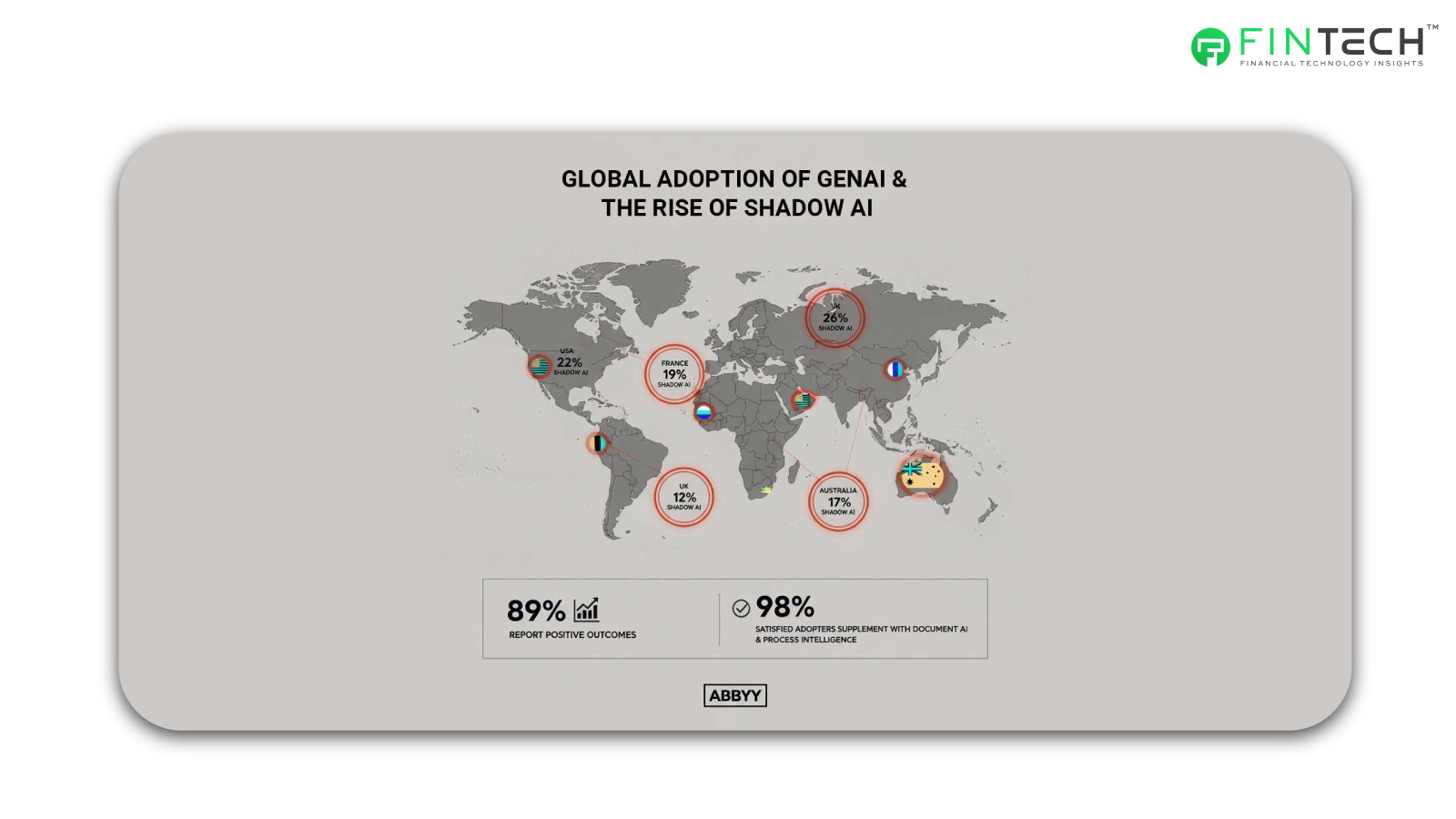
At first glance, this might sound like a governance nightmare. But a closer look shows something different: it’s a reflection of growing curiosity and confidence among employees who see immediate value in GenAI. They’re not waiting for corporate mandates; they’re finding ways to work smarter, communicate better, and solve problems faster.
ABBYY’s report highlights that 41 percent of organizations formally introduced GenAI after employees had already been using it informally through Bring Your Own Software (BYOS). In other words, innovation started at the grassroots level and pushed leadership to catch up.
Of course, this shift also demands structure. Without clear frameworks, Shadow AI can raise compliance and data privacy concerns, especially in sensitive sectors like FinTech. Yet, rather than viewing it as a threat, many forward-looking firms now see it as a valuable signal: employees are ready and eager to embrace automation.
The real opportunity lies in channeling that enthusiasm into organized, ethical adoption. By pairing curiosity with governance, businesses can create a culture where innovation thrives safely.
It’s a reminder that the future of GenAI in FinTech won’t just be shaped in boardrooms; it will be co-created by the very people using these tools every day.
Regional Insights: A Tale of Six Economies
ABBYY’s 2025 survey offers a rare global snapshot of how different economies are navigating the GenAI transformation. Each region brings its own priorities, challenges, and pace, but together, they reflect a shared ambition to make AI an integral part of the digital enterprise.
In the United States, adoption is both widespread and pragmatic. Forty-three percent of organizations say employee enthusiasm drove GenAI implementation, while 27 percent found that training AI models was harder than expected. Integration challenges and model hallucinations are also common, but they haven’t slowed investment.
Across the Atlantic, France stands out as the most optimistic market. A striking 98 percent of French companies plan to increase their AI budgets in 2026. Yet this optimism comes with a caveat: skills shortages and governance gaps remain their biggest barriers to scaling GenAI effectively.
The United Kingdom shows a more measured approach. Thirty-two percent of leaders say deploying GenAI remains difficult, while 30 percent cite training complexity. Shadow AI use is lower, signaling stricter IT oversight and possibly more cautious experimentation.
In the Asia-Pacific region, momentum is equally strong. Australia reports challenges in model training, integration, and governance, but adoption continues to rise steadily.
Meanwhile, Singapore, one of the most digitally mature economies in the survey, leads in shadow AI usage. For many Singaporean professionals, GenAI has become a personal productivity partner, helping reduce burnout and inspire creativity.
Across all six economies, one insight stands out: governance maturity often trails innovation speed. The most successful adopters are those blending enthusiasm with accountability, establishing clear rules, ethical frameworks, and measurable outcomes.
This global diversity in adoption styles reveals a larger truth: while AI may be a universal technology, its impact is profoundly local, shaped by regulation, culture, and readiness to adapt.
GenAI in FinTech: Transformation from Within
The numbers confirm what many industry insiders already sense: the era of GenAI in FinTech isn’t just emerging, it’s accelerating. The technology is now embedded in day-to-day workflows, reshaping how institutions detect fraud, process data, manage compliance, and engage with customers.
Customer-facing use cases such as chatbots and intelligent advisory systems follow closely at 55 percent. For banks, these tools translate into faster onboarding, more accurate credit decisions, and improved regulatory compliance. For employees, they mean fewer repetitive tasks and more time for analytical, high-value work.
Interestingly, ABBYY’s findings reveal a strong human motivation behind adoption. Thirty-five percent of respondents hope Gen AI will reduce burnout, while one in four expect it to improve overall job satisfaction. Rather than replacing talent, the technology is amplifying it, turning complex manual tasks into opportunities for creativity and insight.
Finance teams now rely on Gen AI for everything from cash flow optimization to fraud pattern detection. Sales and marketing teams leverage it for hyper-personalized customer interactions. Compliance and legal departments use it to streamline documentation and audit workflows. The result? Faster turnaround times, better accuracy, and a renewed sense of confidence in data-driven decision-making.
However, the report also reveals an important nuance. Forty percent of financial institutions say GenAI adoption began informally, led by employees experimenting through Bring Your Own Software (BYOS) initiatives.
When paired with structured training and oversight, that same enthusiasm becomes an engine for transformation. The takeaway is that the most successful FinTech firms are using AI to elevate.
Investment Outlook: Budgets Reflect Belief
The ABBYY survey shows that financial institutions aren’t just experimenting with GenAI, they’re backing it with serious investment. Across the board, most organizations expect moderate AI budget increases of 16–22 percent in 2026, with 44 percent of financial services firms projecting growth above 20 percent.
Only a small minority, 11 percent, anticipate leaps of 50 percent or more, reflecting a measured, strategic approach rather than speculative spending.
Investment patterns reveal more than just financial commitment; they indicate a belief in AI’s transformative potential. Leaders recognize that automating repetitive tasks, enhancing data analysis, and boosting customer service efficiency aren’t peripheral gains; they’re essential for remaining competitive in a rapidly evolving financial ecosystem.
Crucially, ABBYY’s research highlights that spending alone isn’t enough. Budget allocations must be paired with governance frameworks, training programs, and integration strategies to realize the full benefits of GenAI.
“Businesses are spending money on GenAI tools that promise more than they can provide. In some cases, they don’t even need it. Before moving forward with GenAI tools for agentic automation, companies need to first evaluate their current processes and create a visibility map of their workflow with data analytics tools such as process intelligence,” stated Maxime Vermeir, Senior Director of AI Strategy, ABBYY.
Ultimately, the data makes one point clear: GenAI in FinTech is now essential. Institutions that proactively invest, both in technology and in the people who use it, are positioning themselves to lead in innovation, efficiency, and customer experience over the next decade.
The Governance Imperative: Building Trust and Transparency
As GenAI in FinTech adoption accelerates, one insight from ABBYY’s survey stands out: governance is no longer optional; it’s foundational. While employees enthusiastically experiment with AI tools, 26 percent of organizations report a lack of governance frameworks, and 21 percent note occasional misuse. Left unchecked, this can create operational risk, regulatory exposure, and erosion of trust.
Forward-looking financial institutions are addressing this proactively. Governance today isn’t just about compliance checklists; it’s about embedding transparency, accountability, and ethical decision-making into AI workflows.
For example, structured training programs ensure staff understand not only how to deploy models but also how to interpret outputs responsibly. Organizations supplement GenAI with tools like ABBYY Document AI and Process Intelligence, creating controlled environments where automation and human judgment coexist seamlessly.
ABBYY’s regional data underscores the nuance of governance. In Australia, 29 percent of firms cite governance challenges, while Singapore’s 26 percent shadow AI prevalence highlights the need for structured oversight without stifling creativity.
Even in regions with lower shadow AI adoption, such as the UK at 12 percent, companies are recognizing that a formal governance framework accelerates adoption while reducing risk.
The benefits of governance extend beyond risk mitigation. Transparent policies and ethical use build employee trust, reinforce customer confidence, and foster a culture where innovation is encouraged rather than constrained.
When governance is thoughtfully implemented, it transforms from a procedural hurdle into a strategic enabler, guiding GenAI adoption toward measurable business outcomes.
In essence, ABBYY’s research illustrates a simple truth: successful GenAI adoption in FinTech requires balance. Curiosity, creativity, and technical capability must operate alongside robust governance.
Institutions that master this balance position themselves not only to leverage AI for efficiency but also to strengthen credibility, trust, and resilience in a fast-evolving financial landscape.
What ABBYY’s Findings Mean for Financial Leaders
The report paints a compelling picture of GenAI in FinTech as a technology that is reshaping how financial institutions think about strategy, talent, and culture.
Across six major economies, firms are discovering that AI adoption is most successful when innovation, governance, and human expertise converge. ABBYY’s data shows that 40 percent of firms began adopting GenAI through employee-led initiatives, evidence that innovation often starts at the grassroots level.
Financial services teams will continue to leverage GenAI across fraud detection, data analysis, customer engagement, and compliance. The next wave of impact will come from integrated, multi-layered AI systems that combine Document AI, process intelligence, and Retrieval Augmented Generation.
Institutions that prioritize training, ethical use, and governance will see higher adoption rates, reduced errors, and stronger employee engagement.
Moreover, ABBYY’s findings reinforce the idea that AI adoption is about culture, not just technology. Empowered employees, ethical guidelines, and transparent processes are as critical to success as the algorithms themselves.
Forward-looking executives understand that a responsible approach to GenAI doesn’t slow innovation; it accelerates it by building trust, enhancing productivity, and enabling strategic agility.
Shaping the Future of Financial Innovation with GenAI
GenAI in FinTech is a catalyst for transformation. From automating complex workflows to empowering employees and enhancing decision-making, AI is redefining how financial institutions operate, innovate, and compete.
Yet, the true power of GenAI emerges when technology meets purpose. Forward-thinking firms are pairing AI adoption with strong governance, structured training, and ethical frameworks, ensuring that innovation scales responsibly. Shadow AI and employee-led experimentation, once seen as risks, are now signals of a culture ready to embrace change, adapt quickly, and lead with confidence.
For financial leaders, the takeaway is both simple and profound: success will favor those who view GenAI not merely as a tool, but as a strategic partner in shaping the future of finance. By blending human insight with intelligent automation, organizations can unlock productivity, trust, and creativity at unprecedented levels.
In a world where speed, precision, and adaptability define competitive advantage, the firms that harness GenAI responsibly will not only thrive, they will redefine what is possible for the entire financial ecosystem.
FAQs
1. How is GenAI currently used in FinTech?
Financial institutions leverage GenAI to automate document workflows, enhance data analysis, improve fraud detection, and provide personalized customer service. It helps teams work faster and more accurately, while reducing repetitive tasks.
2. What makes ABBYY’s latest report significant for financial leaders?
ABBYY’s survey captures insights from 1,200 executives across six major economies, offering a comprehensive view of adoption trends, employee-led initiatives, and governance challenges. It highlights how GenAI in FinTech is being deployed both strategically and informally.
3. Why is Shadow AI an important consideration?
Shadow AI occurs when employees adopt AI tools independently. While it reflects innovation and curiosity, it also signals a need for governance, ethical guidelines, and oversight to ensure compliance and secure data handling.
4. How can financial organizations adopt GenAI responsibly?
Success comes from combining GenAI with tools like Document AI and process intelligence, creating structured training programs, and establishing clear governance frameworks. This approach maximizes efficiency while maintaining ethical and regulatory standards.
5. What does the future hold for GenAI in FinTech?
Expect deeper integration into core operations, enhanced collaboration between humans and AI, and more strategic investments in skills and governance. Firms that balance innovation with oversight will lead the next phase of financial transformation.
To participate in upcoming interviews, please contact us at info@intentamplify.com