

A new data release from real-time aggregator Obi offers one of the first large-scale empirical comparisons of pricing, wait times, and rider sentiments across Tesla and Waymo services in the San Francisco Bay Area.
Independent rideshare pricing data shows a clear divergence between the two autonomous models. Tesla’s robotaxi fares typically fall in the $7–$9 range per trip, while Waymo’s comparable rides average $15–$20, creating a pricing gap of more than 120 percent in overlapping markets.

The delta between Tesla and Waymo, more than 130 percent in median price difference, is not a rounding error. It’s a strategic artifact.
The robotaxi market has measurable pricing behaviors, observable consumer patterns, and real competitive dynamics that reveal how autonomous mobility might reshape not just urban transport but the economics of on-demand services generally.
“Obi’s riders have been enthusiastically adopting robotaxis – we see every day that the demand is very real, and it mimics what we see in survey data,” said Obi’s CEO, Ashwini Anburajan. “At Obi, we’re proud to have the best global rideshare data, which gives us the ability to access these insights into how the ways we get around are changing.”
Different Pricing Philosophies, Different Signals
At the center of the Obi dataset (94,348 discrete rides from late November 2025 through early January 2026) is a stark contrast in unit prices. Tesla is clearly using pricing as a market penetration signal rather than as cost recovery.
Anburajan described this as “a wholly new approach to pricing rideshare,” noting that Tesla’s fares “virtually never surge” and intentionally undercut existing options to drive adoption.
Waymo, on the other hand, appears to be moving toward relative pricing parity with incumbent human-driven ride-hailing. Obi’s broader analysis shows that the premium Waymo originally commanded 30–40 percent above Uber and Lyft in mid-2025 has narrowed to a range closer to 12.7 percent above.
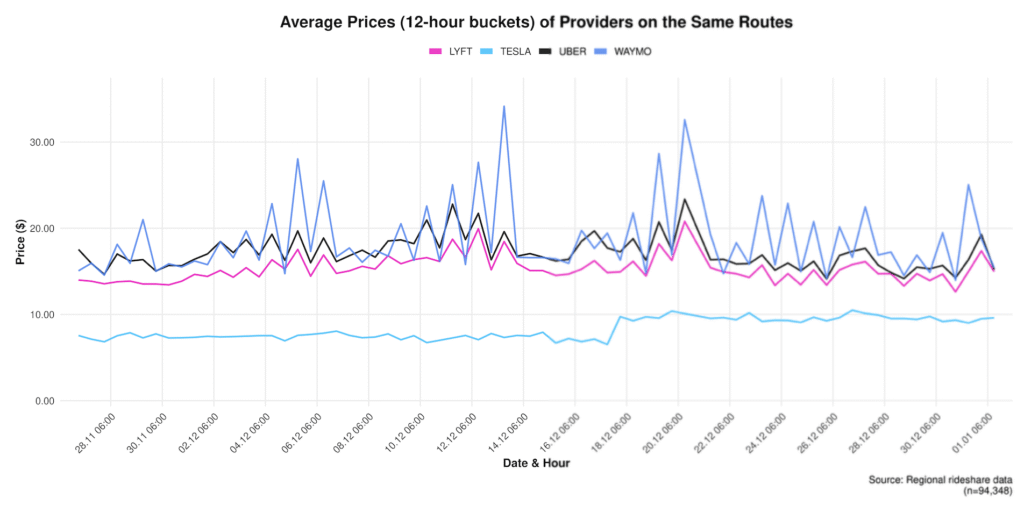
Uber and 27.3 percent above Lyft. That shift reflects both Waymo price reductions and rising prices in traditional services.
For fintech strategists, these are not idle numbers. They illustrate two divergent contexts: one service subsidizing to capture demand and data, and another balancing cost structure with perceived quality. Each has implications for pricing algorithm design, customer segmentation, and long-term monetization strategies.
Wait Times Reveal Hidden Price Costs
Low pricing alone isn’t a win if wait times undermine the value proposition. Here again, the Obi dataset exposes meaningful differentiation.
Tesla’s average estimated arrival times (ETAs) were roughly 15.3 minutes, significantly higher than those of competitors.
In contrast, Waymo’s ETAs hover near 5.74 minutes, often shorter than Lyft and approaching parity with Uber outside peak hours.
This correlates with perceived service value in the real world. Empirical research on on-demand services shows consumers are far more sensitive to predictability and service assurance than raw price, especially in urban environments where time equals money.
The astrophysics model underpinning this (where price combines with latency to determine net utility) is supported by behavioral findings observed across ride-hailing users; see broader demand elasticity research in mobility pricing economics.
For instance, a $7 ride that takes 15 minutes to appear may not feel cheaper when compared to a $15 ride that arrives in under six minutes. Consumers trade off price against certainty and immediacy in predictable ways.
Sentiment Trends Signal Trust, Not Just Demand
Beyond observable price and arrival time data, ObI’s concurrent sentiment survey adds a human dimension. Key findings from respondents in California, Arizona, Texas, and Nevada include:
- 63 percent say they are comfortable with AV services, up from 35 percent in Obi’s spring 2025 survey.
- Nearly half view autonomous vehicles as a potential primary mode of rideshare in the future.
- Safety remains the top concern, followed by technology reliability and data privacy anxiety.
- A gender gap in trust persists, with women systematically less likely than men to express confidence in autonomous systems for sensitive use cases.

For fintech risk teams, rising comfort levels with autonomous systems hint at transactional volume growth, but persistent safety and privacy concerns imply trust friction points that could translate into higher dispute rates, refund requests, or churn.
Tesla’s Pricing Strategy
Tesla’s aggressive pricing playbook recalls the early years of Uber and Lyft, where venture capital subsidized per-ride losses to build scale. While this might attract riders in the short term, the long-term viability hinges on two unresolved questions:
Fleet scale and density
Tesla’s robotaxi service remains small relative to Waymo’s thousands of vehicles across multiple cities (Waymo reported about 2,500 robotaxis in service and ~450,000 paid rides weekly as of late 2025).
Regulatory maturity
Tesla operates under permits that currently require safety drivers in many areas, limiting its true autonomous yield.
This positions Tesla’s pricing less as a sustainable economic model and more as a data-acquisition and habituation strategy.
This raises a key risk: pricing distortions driven by subsidized acquisition are not the same as pricing determined by cost recovery and yield optimization.
Waymo’s Evolution: Quality with Relative Price Discipline
Waymo’s relative pricing elevation has drawn criticism from some quarters in the past. However, the recent convergence with traditional ride-hailing pricing suggests an intentional alignment with observed willingness to pay rather than an outlier premium.
Waymo’s average ETA is 5.74 minutes. Outside of a peak demand time in the afternoon when Waymo ETAs are significantly longer, the robotaxi pioneer’s wait times are frequently shorter than Uber’s and are getting closer to Lyft’s at many times of the day.
Integrated with improved ETAs, this represents a calibrated approach to balancing cost of service, operational overhead, and market expectations.
In similar network economics observed across fintech platforms, services that maintain predictable pricing and delivery consistency tend to generate stickier adoption curves, even if they don’t offer the lowest headline prices.
Fintech Insights Analysis: Navigating Shifting Pricing Ecosystems
Costs, wait times, and sentiment patterns in the robotaxi market illuminate broader themes relevant to fintech decision-makers:
- Dynamic pricing must integrate latency and service quality signals, not just demand forecasts. Algorithms that optimize for price alone can fail when delivery unpredictability weakens overall utility.
- Trust and safety perceptions matter as much as rational cost minimization. In financial products, analogous trust factors (fraud risk, chargeback likelihood) can outweigh marginal price improvements.
- Subsidized pricing strategies may distort long-term risk models. Underwriting, discounting, and loyalty program forecasts need to account for temporary promotional effects versus structural unit economics.
Conclusion: Pricing Patterns as Predictive Signals
Tesla and Waymo represent two ends of the emerging autonomous rideshare pricing spectrum. One aggressively subsidized, the other increasingly calibrated with real cost signals.
Obi data doesn’t just quantify differences between two services. It reveals how advanced algorithmic pricing, consumer expectations, and real-world performance interplay in a nascent market.
Analyzing this battleground offers actionable insights into pricing architecture, risk modeling around unpredictable service variables, and the human factors that mediate technology adoption.
Autonomous mobility is a live test of how algorithmic pricing and real users interact in high-stakes, real-time environments.
FAQs
1. Why is Tesla’s robotaxi pricing significantly lower than Waymo’s?
Tesla is using pricing as a market-entry and data-acquisition lever rather than a cost-recovery mechanism. Lower fares accelerate rider adoption and real-world autonomy training, even if margins are negative in the short term.
2. How does Waymo justify higher rideshare prices in autonomous markets?
Waymo prices in operational certainty. Its higher fares reflect fleet redundancy, regulatory compliance costs, and consistently shorter wait times, which translate into higher reliability and user trust.
3. What do wait times reveal about autonomous rideshare economics?
Wait times act as a hidden price variable. Predictable, shorter ETAs increase perceived value and reduce churn, while long or volatile waits erode trust even when fares are lower. This mirrors liquidity and fulfillment risk in fintech platforms.
4. How does consumer sentiment impact autonomous rideshare pricing strategies?
Rider sentiment correlates more strongly with reliability and safety than with price alone. Data shows users tolerate higher fares when service consistency is high, making trust a more durable economic asset than discounting.
5. What can fintech leaders learn from Tesla vs Waymo pricing models?
Autonomous rideshare exposes how algorithmic pricing behaves under real-world constraints. The lesson is clear. Pricing models must integrate fulfillment reliability, regulatory cost, and trust signals, not just demand elasticity.
To share your insights with the FinTech Newsroom, please write to us at info@intentamplify.com