


Elon Musk’s Vision and implications for money and financial technology suggested that a future shaped by advanced technology could eliminate poverty and, eventually, the need to save money. This statement, delivered recently and without policy framing, landed less as a prediction and more as a worldview.
A belief that intelligence, energy, and production will become so abundant that financial scarcity loses relevance. For fintech leaders, this is not a thought experiment. It is a stress test. Not of balance sheets, but of assumptions. Musk has a track record of compressing timelines that others consider theoretical.
Money, however, occupies a different role than rockets or electric vehicles. It is not just an optimization problem. It is a system for managing uncertainty.
Post-Scarcity Is Not a Financial Abstraction
The idea that saving becomes unnecessary assumes a post-scarcity economy. Goods and services are cheap, accessible, and reliably available. Income volatility ceases to matter. History offers little support for that leap. Every productivity revolution. Industrialization, electrification, and the internet. Expanded output but did not remove financial risk. It redistributed it.
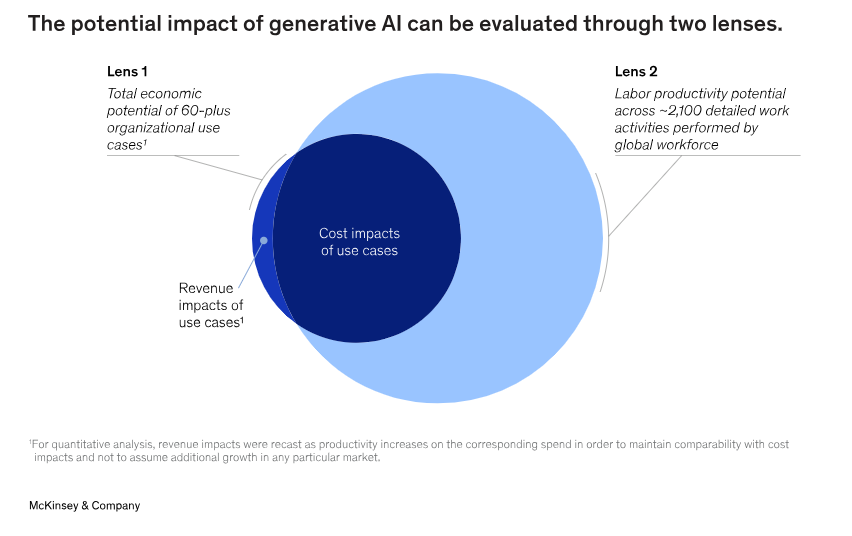
AI follows the same pattern. McKinsey’s 2024 Global Institute estimates that generative AI could contribute $2.6 trillion to $4.4 trillion annually to global GDP, largely through automation of cognitive work. That value does not diffuse evenly. It concentrates on those who control models, data, and compute infrastructure. Abundance in production does not eliminate scarcity in ownership.
Money persists because uncertainty persists. Health concerns arise. Employment transitions. Geopolitical instability. Even in high-income economies, the need to buffer against volatility has not declined. It has intensified.
Fintech’s Real Exposure Is Not Deposits
The near-term implication of Musk’s framing is not that consumers stop saving. It is that traditional financial narratives lose traction. Younger users already experience money as abstract. Invisible balances. Auto-swept accounts. Embedded credit inside platforms that they do not perceive as financial institutions.
Data from 2025 shows that fintech firms are moving fastest when it comes to agentic and AI-driven uses. According to a recent report cited by Asian Banking & Finance, fintechs, not traditional banks, account for nearly 70 percent of AI initiatives globally.
As AI increases income variability through job displacement and role fragmentation, the demand shifts. Not away from money, but away from rigid products built around accumulation. Savings accounts, retirement plans, and long-horizon instruments still matter. But they are no longer the emotional center of financial decision-making. Access, flexibility, and timing matter more.
The Contradiction Musk Leaves Unresolved
There is an unresolved tension in Musk’s claim. His own companies depend on capital intensity, financing structures, and long-duration risk. None operates in a post-scarcity environment. AI training requires an enormous upfront investment. Energy infrastructure is constrained. Capital markets remain selective.
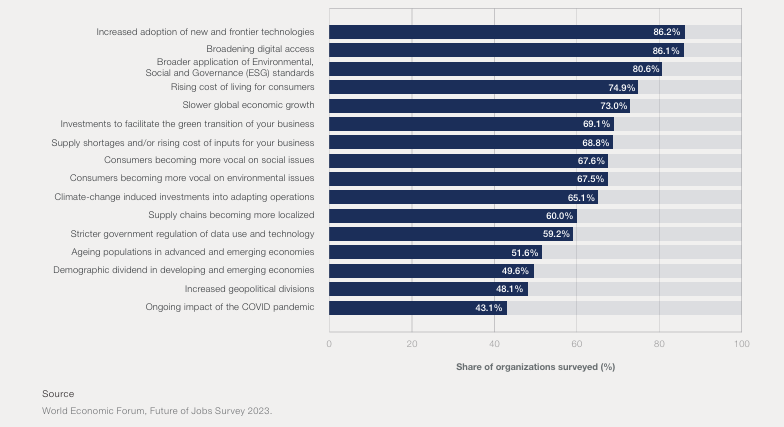
This contradiction is instructive. Productivity gains can coexist with widening inequality. The World Economic Forum’s 2024 Future of Jobs report projects that 44 percent of worker skills will be disrupted by 2028. Disruption does not mean disappearance. It means transition. Transition introduces financial fragility.
Fintech systems are built to absorb that fragility. Payments, credit, insurance, identity. If ownership concentrates while labor becomes more fluid, money’s role shifts from accumulation to stabilization. Platforms that ignore this shift misread the signal.
Risk Does Not Disappear With Abundance
For CISOs in fintech, a post-scarcity narrative offers no relief. If anything, it raises the stakes. Automation widens the attack surface by design. Embedded finance pushes sensitive transactions into third-party platforms, APIs, and ecosystems that security teams do not fully control.
As AI lowers the cost of scale for attackers, fraud tactics evolve faster than rule-based and retrospective controls can keep up. The result is no more incidents. There is more ambiguity. Synthetic identities, automated social engineering, and model-driven abuse blur the line between legitimate and malicious behavior. Trust signals that once anchored risk decisions. Device reputation, behavioral baselines, static identity markers. degrade under adversarial AI pressure.
In this environment, security leadership shifts. Prevention remains necessary, but it is no longer sufficient. CISOs are judged on resilience. How quickly anomalous activity is detected and how decisively it is contained. Also, how transparently systems recover without eroding customer trust. In a financial system that assumes frictionless access and constant availability, even brief interruptions feel disproportionate. Not as outages, but as failures of confidence.
An Idea That Gives Rise To More Questions
Musk’s vision is compelling precisely because it challenges assumptions that most financial systems take for granted. However, it also glosses over structural realities. Technology can expand supply and compress costs. It does not, on its own, resolve questions of ownership, governance, or distribution. Abundance without institutional redesign has historically produced concentration, not equity.
A future where saving is unnecessary would require more than AI-driven productivity. It would demand new social contracts around income stability, access to capital, and risk sharing. Those are policy decisions as much as technological outcomes. They are contested, slow-moving, and deeply political.
Still, dismissing the idea outright would be a mistake. Musk’s provocation matters not because it is likely to arrive intact, but because it reframes the conversation. It forces fintech, policymakers, and financial leaders to confront a shift already underway. Work is becoming less linear. Income is less predictable. Value creation is more uneven.
Whether or not a post-scarcity world materializes, the pressure on money’s role is real. The institutions that survive this transition will be the ones that understand money not as an end state, but as infrastructure for navigating uncertainty in a system that is changing faster than its assumptions.
FAQs
1. What does Elon Musk’s post-scarcity vision mean for the future of money?
Musk’s vision suggests that technology could reduce the economic importance of accumulation, but money would still function as infrastructure for managing risk, access, and uncertainty. Fintech systems would evolve rather than disappear.
2. Will AI and automation reduce the need for saving and traditional financial products?
AI may change how income is earned and distributed, but volatility increases demand for liquidity, flexible credit, and risk buffering. Traditional products will persist, but their design assumptions will shift.
3. How should fintech leaders prepare for a future shaped by AI-driven economic abundance?
Leaders should prioritize adaptability over scale. Products must handle income variability, embedded finance, and real-time decisioning while maintaining trust, compliance, and resilience under AI-driven pressure.
4. Why does AI-driven abundance increase cybersecurity risk in financial services?
Automation expands attack surfaces and lowers the cost of fraud at scale. As transactions become more embedded and invisible, trust failures escalate faster, making resilience and rapid response critical for CISOs.
5. Does a post-scarcity economy reduce the relevance of fintech and banks?
It shifts relevance. Financial institutions move from facilitating accumulation to enabling access, stability, and coordination across increasingly fragmented economic activity.
Read our latest collection of fintech blogs:
Automating Know-Your-Customer (KYC) and Anti-Money Laundering (AML) Processes
Document Automation for Loan Origination: Reducing Fraud in Credit Risk Assessment
Risk-Based Pricing and Fraud Prevention in Digital Lending
To participate in upcoming interviews, please contact us at info@intentamplify.com