

AI-powered embedded finance is revolutionizing fintech at an unprecedented rate by embedding financial services into existing digital platforms.
Extremely different from traditional banking, embedded finance allows businesses to offer, without leaving their app, services that include payments, lending, insurance, and investments.
In 2025, through the embedding of artificial intelligence, embedded finance will also offer even smarter decision-making, personalization strategies in real-time, and improved efficiencies by managing operations intelligently.
Various industries are already applying AI to analyze customers’ behavior, assess risk, and leverage coordination across processes. This yields financial experiences that are faster, more secure, and highly personalized.
From e-commerce providers offering instant credit to ride-sharing providers integrating in-app digital wallets, the embedded finance sector has altered the user experience in relation to accessing and managing their money.
As technology continues to evolve outside of strategy and ultimately becomes a valued solution, it can no longer be considered a niche.
In a digital economy that increasingly values speed and personalized solutions, AI-powered embedded finance is on track to become a foundational shift in modern financial service offerings.
What Is AI-Powered Embedded Finance?
AI-enabled embedded finance seamlessly integrates financial services into various platforms, which are primarily non-financial, incorporating AI.
Traditional banking relies on using separate apps and portals to provide services, while embedded finance offers opportunities for payments, lending, insurance, and investment services to be made accessible directly on the platforms people use all the time.
As with traditional embedded finance offerings, AI strengthens financial services integrations by:
- Making real-time personalization available to the user.
- Automatically detecting and preventing fraud.
- Quick, accurate, and effective risk assessment.
- Automating financial decision-making according to customer behavior.
Business Impact at a Glance
AI-enabled embedded finance brings meaningful value to customers and businesses. For businesses, it means:
- Lower costs through automation and efficiency gains.
- New revenue streams through integrated financial services.
- Greater customer loyalty and engagement.
For customers, it means:
- Speed and convenience of managing finances.
- Smarter, tailored financial options right in their existing experience.
Embedded finance is one of the main drivers for growth across Industries. Businesses, including e-commerce, retail, ride-sharing, and fintech, continue to explore ways to gain a competitive advantage.
These advantages are not hypothetical. Companies from various segments are already demonstrating how AI-enabled embedded finance reshapes user experience and enhances financial inclusion.
Real-World Use Cases
Let us look at some real-world use cases of AI-powered embedded finance to provide insights into how companies use technology to provide faster, smarter, and more inclusive financial products.
Carro (Southeast Asia): AI-Enabled Automotive Lending
Overview:
Carro’s affiliate, Genie Finance, utilizes generative AI across the lending lifecycle from loan application to underwriting and customer management.
The application assesses vehicle data, driving behaviour, and maintenance records, allowing for unlikely credit approvals and reducing the need for manual review.
Here are some key metrics as reported by Insignia Ventures Partners.
Key metrics:
- Days to process funding reduced to 5 minutes.
- Operational cost reduced by 40%.
- Portfolio performance remains strong despite the riskiest clients.
Why this is important:
- Speeding up the financing decision process while reducing overhead costs.
- Enabling usage-based insurance and pricing based on real-world driver behaviour.
- Increasing financial inclusion by serving riskier and underbanked customer segments.
Shopify: AI-Financed Solutions for Merchants
Overview:
Shopify employs AI across its platform to provide embedded financial services, including a boutique model of instant financing, alongside guided personalized financial advice for merchants.
Key Statistics:
- Rise in overall revenue: According to DigitalCommmerce360, Shopify’s revenue for the quarter was $2.68 billion as of Q2 2025. This was a 31.05% increase from Q2 2024.
- Rise in Merchant Solutions revenue: Shopify’s Merchant Solutions revenue increased by 37%. It appears merchants are welcoming Shopify’s tools to provide embedded financial products.
Why this matters:
- Allowing small and midsized businesses to secure instant financing without waiting for days in a traditional banking environment.
- Enabling merchants to receive customized financial advice to help stabilize their businesses.
- Amplifying the adoption of digital-first commerce tools via embedded finance.
Klarna: Using AI to Provide Personalized Financial Services
Overview:
Klarna’s backbone is its use of AI for personalized financial services. That includes custom payment plans and credit offerings at the point of sale on e-commerce.
Key Statistics:
- Revenue: Klarna made 823 million in revenue in Q2 2025 – up 20% from the year before.
- Active Users: Klarna reported 111 million active consumers as well as 790,000 merchant partners.
Why this matters:
- Allowing shoppers to have individualized payment options that enhance the checkout experience and loyalty.
- Helping merchants increase sales conversions with flexible credit offered as an embedded payment option.
- Increasing financial access for consumers who may not be served by traditional banks.
Top Takeaways on this market outlook:
- Embedded finance is evolving from specialized solutions to a core business fundamental.
- AI integration is a primary contributor toward scale and personalization.
- Digital ecosystems are emerging as a primary channel for delivering financial services.
With the examples of Carro, Shopify, and Klarna, AI-embedded financial services are solidifying customer experience, but evolving financial infrastructure too.
The graph below reiterates these larger shifts, and the next section key trends will break these down further.
The Growth Trajectory of Embedded Finance
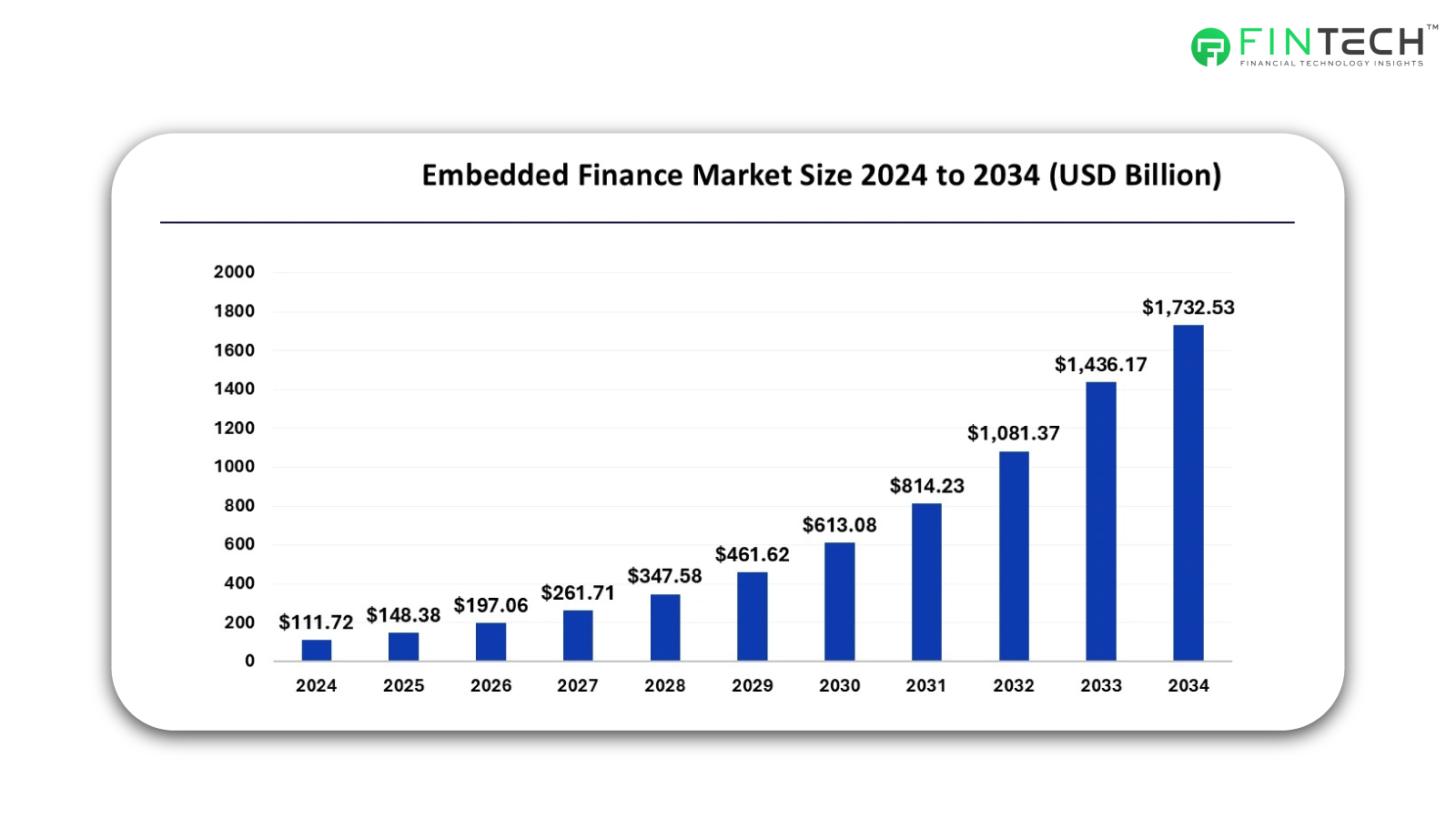
The projected growth of the embedded finance market is staggering! The global market value is projected to be USD 148.4 billion in 2025 and USD 1.73 trillion in 2034, at a CAGR of 31.5% This growth highlights embedded finance’s evolution from specialized use cases to a primary consideration for competitive advantage.
Key Trends Driving AI-Powered Embedded Finance in 2025
1. Hyper-Personalization Through AI
AI grants financial services the ability to personalize based on unique needs.
Offers are determined from patterns in spending habits, risk profile, and how the individual has behaved with their money in the past.
Customers receive personalized loans, insurance, or payment offers within the digital channels they use.
Strategic Takeaway:
Personalization creates trust and promotes engagement. Businesses can cultivate loyalty from the customer base while tapping into new revenue streams.
2. Real-Time Assessment of Creditworthiness and Risk
AI can provide an instantaneous assessment of creditworthiness.
It can assess creditworthiness using alternative data, which may be from transactions, geolocation, or purchasing history. AI eliminates the need for lengthy paper checks and allows for real-time decisions,
Strategic Takeaway:
Faster assessments of risk can allow for greater inclusion and minimize any defaults.
Entering markets quicker with the time gained can provide businesses with both certainty of speed along customer acquisition.
3. AI Fraud Detection and Security
With the growth of digital payments, the risks of fraud grow.
AI can identify anomalous behaviour quickly and efficiently, which is critical for keeping users safe while moving money quickly.
Strategic Takeaway:
Good fraud detection will protect customers and provide credibility in the platform itself, while also mitigating financial and regulatory slippage.
4. Expansion Across Non-Financial Platforms
Embedded finance is growing quickly beyond just fintech firms. E-commerce, health care, and mobility apps are adopting payments, loans, and insurance.
Artificial intelligence (AI) makes this faster and easier.
Strategic Takeaway:
The difference between financial platforms and non-financial platforms is dissipating.
The early adopters will have ecosystem benefits.
5. Regulatory Alignment and Automating Compliance
AI supports compliance in real-time. It monitors the transactions, identifies any risk, and validates that KYC/AML standards are met.
This functionality reduces manual work and lowers operational lags.
Strategic Takeaway:
Automated compliance enables growth with less risk. Companies can scale responsibly while regulators and customers feel confident.
These trends illustrate the evolution of AI-led embedded finance from pilot implementations to consumer adoption and formal use in 2025.
What once were “nice-to-haves” will soon be new “must-have” components of digital ecosystems.
Firms prepared to act on these trends will not only provide quicker, safer, and more relevant financial services but will also cement their strategic role in a lively and treacherous fintech world.
While we know AI-accelerated embedded finance is innovating with incredible speed, it is also complex. Adoption trends will rely on these developments.
This includes risk responses and risk mitigation, which must be considered in context with trust, stability, and long-term adoption and usage. And as the technology continues to evolve, there will be more focus on these things.
Challenges and Risks of AI-Powered Embedded Finance
AI-based embedded finance presents brilliant opportunities; however, it carries an appropriate amount of challenges that companies will need to face.
The challenges are closely tied to a range of technical and regulatory complexities, and issues of trust that companies will need to resolve upfront to offer a framework for lasting adoption of AI-based embedded finance.
-
Data Security and Privacy
For AI to function properly, AI needs to collect and analyse a large volume of customer personal and financial information. If protective measures are not in place, businesses risk being held liable for breaches of the privacy and forensic use of that information.
-
Algorithmic Fairness and Bias
The issue of a biased model against data has led to unfair financial results. The best example is loans and/or insurance payments issued to the poorest 25% of income generators.
As that group continues to remain unplugged from the funding mainstream, we will always have an issue with financial inequality in our communities.
-
Regulatory and Compliance
As we all know, regulations do not move as fast as technology is progressing.
In the case of cross-border services, the regulatory reach can put a business at risk of compliance failures.
-
Technical Issues of Integration
Integrating financial services into codebases is almost never seamless. It can often expose challenges with legacy infrastructure or compliance with multiple parties and/or fragmented standards or networks.
Companies should seriously consider investing in API frameworks or interoperability.
-
Trust and Adoption
Customers can be apprehensive about allowing non-financial platforms to offer such sensitive financial services.
Concerns over the prospect of trustworthiness and transparency of the sought-after services may put the brakes on the extent of further adoption. Trust takes time and requires an emphasis on a particular business ethos.
Practical Implications
The implications for embedded finance and AI are profound. The issues we are experiencing in unique dimensions of AI embedded finance suggest a shift based on responsibility, while we acknowledge a technical shift as well.
Working in this way, organizations would also be able to do so with adequate and transparent governance, and develop an ecosystem of innovation which could lead to long-lasting behavioural change.
Conclusion
AI-driven embedded finance has evolved from a burgeoning trend to a transformational part of the financial services landscape in 2025, bringing together intelligence with integrated experiences for quicker decisions, more personalized experiences, and greater financial inclusion.
For businesses, embedded finance makes their operations more efficient, while for consumers, it brings convenience and trust. As it becomes mainstream, organizations that adeptly provide AI-driven embedded finance solutions will define this next era of innovation in fintech.
FAQs
1. What does the future hold for AI-enabled embedded finance?
Growing rapidly. AI will allow hyper-personalization, embedded compliance, and partnerships across industries that are redefining financial ecosystems.
2. How does embedded finance promote financial inclusion?
It extends access to credit, insurance, and payments by accessing AI-driven insights that optimize risk assessment as the underserved or underbanked populations begin to more frequently engage in these financial transactions.
3. Is embedded finance replacing traditional banking?
Not necessarily. It’s not replacing banking, but finding a way to augment banking’s role in providing customers with more convenient access to financial services on digital platforms they are constantly using.
4. How is AI enhancing embedded finance?
AI provides fast, real-time personalization and fraud prevention/detection, rapid credit decisions, and predictive insights that should make financial services easier and more efficient.
5. What industries will find the most benefit from embedded finance?
We will see the most significant progression of embedded finance where AI-enabled financial services are incorporated into retail, e-commerce, mobility, healthcare, and B2B platforms.
To participate in our interviews, please write to us at sudipto@intentamplify.com