


At the end of 2025, the idea of AI-native banking being a change of the next decade is no longer valid. It has been changed to the new financial landscape with technology that is more advanced and different than before. Traditional digital banking that uses AI as an add-on to existing systems is different from the latter. Here, the whole unit is AI-driven, that is, the core unit of the bank. This change in the banking system is not just a transient fashion. But it is a fundamental evolution that will deeply alter how banks perform. Also, the manner in which they access their customers.
Understanding AI-Native Banking
AI-native banking is the term that describes banks or financial institutions that were developed entirely with the use of AI as their core. These are not just regular digital banks with a few AI processes. But rather banks that have AI embedded in every single one of their activities. Giving credits, detecting fraud, and even creating unique customer experiences are examples.
By implementing this strategy, banks are enabled to make decisions in real-time. They started executing operations without the need for human labor and mined data for insights. All of this contributes to a more efficient functioning of the organization. And, at the same time, they can provide services that are faster, more accurate, and highly personalized. It is the use of machine learning models, natural language processing, and a secure data infrastructure that is the real foundation for this success. With the aim being not only improving the customer’s happiness but also the bank’s performance.
In other words, AI-native banking means a complete paradigm shift. It is not just the implementation of new technologies that brings the advantages of AI. This is about reshaping the financial institution so that it can be an easy match for AI to bring about gains. These Gains will be in growth, efficiency, and customer engagement of a higher order.
Core Features and Advantages of AI-Native Banking
1. Automated Decision-Making
AI-native banks leverage machine learning models to automate critical decision-making processes, such as credit scoring, loan approvals, and fraud detection. This not only accelerates operations but also enhances accuracy and reduces human error. For instance, JPMorgan Chase has invested approximately $2 billion annually in AI. It is achieving significant efficiencies across various sectors, including risk management and customer service.
2. Personalized Customer Experiences
AI enables banks to customize financial products and services to the individual needs of customers. Customer loyalty and satisfaction are, therefore, considerably raised. A recent study showed that 76% of consumers favor individualized contacts, while the banks that utilized AI-based personalization solutions experienced a 25% increase in customer satisfaction scores.
3. Operational Efficiency and Cost Reduction
AI-native banking automates routine tasks, streamlines workflows, and optimizes resource allocation. This results in significant cost savings and allows financial institutions to allocate resources more effectively. In 2025, 75% of banks with over $100 billion in assets are expected to fully integrate AI strategies, underscoring the industry’s commitment to operational efficiency.
4. Real-time Financial Insights
One of the features of AI-native banks is the use of sophisticated analytics for giving a clear view of the financial health in real-time, hence, the preparation of actions that are ahead of time. This feature is especially important in changing markets where up-to-the-minute data is necessary.
AI Banking 2025 – Key Trends Driving Adoption
1. Generative AI Integration
One of the major trends in the banking sector is the use of Generative AI. This has been progressively implemented in several bank operations. The changes occurred as a result of an effective survey in 2025, where 58% of the banks surveyed are already employing this technology in at least one function. It was different compared to 45% of the same organizations in 2023. This data indicates that organizations are swiftly shifting from traditional to digital services and that advanced AI technologies skills are rapidly being embraced.
2. Regulatory Technology (RegTech) Advancements
AI significantly improves compliance processes that rely heavily on Regulatory Technology (RegTech) solutions. For instance, RegTech solutions make regulatory reporting a facile process by automating it. Along with the automation of reporting, systems can monitor transactions to search for the activities that can be considered suspicious and to keep up with the current regulations. This, in turn, lowers the costs of compliance while at the same time lessening the risk of non-compliance.
3. AI-Powered Customer Support
One of the areas where technology, and specifically AI, has made a big impact is customer service. AI-based chatbots and virtual assistants, equipped with natural language processing abilities, provide an immediate answer to customers’ questions, support them effectively in a self-service mode that is available round the clock. These moves could not only elevate the customers’ experience but also trim down the operating costs of banks.
AI Adoption Across Banking Operations in 2025
The data gathered from current industry reports and trends for 2025 indicates that Fraud Detection is the leading area for AI adoption in the banking sector. The chart below visualizes the estimated percentage of banks using AI across five key operations, using a professional fintech-oriented color palette.
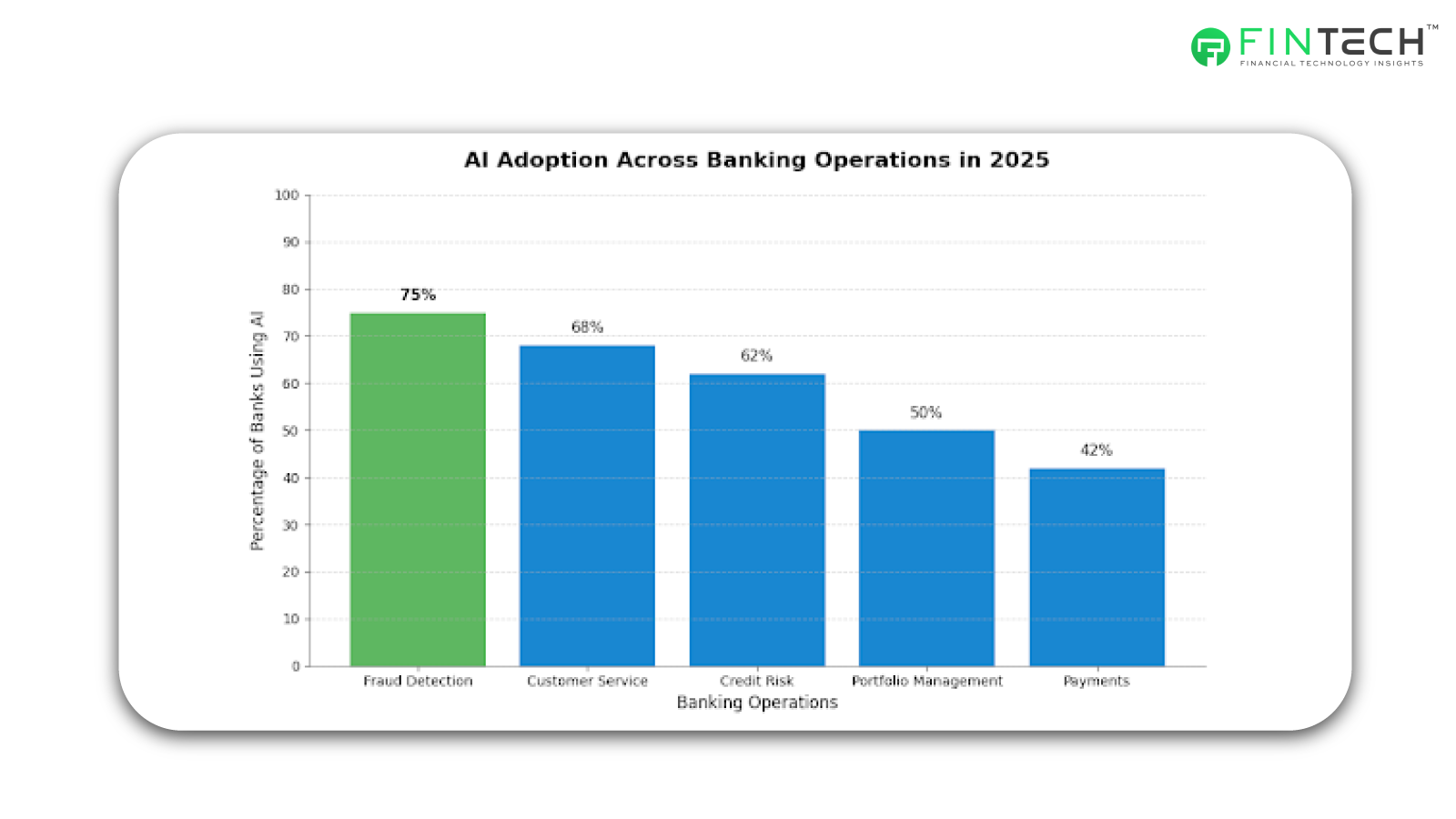
| Banking Operation | Estimated AI Adoption (2025) |
|---|---|
| Fraud Detection | 75% |
| Customer Service | 68% |
| Credit Risk | 62% |
| Portfolio Management | 50% |
| Payments | 42% |
The Future of Next-Gen Banking
In 2025, the incorporation of AI in banking as the core of operations has changed the entire banking system. This method is now being used to get the threefold advantages of banking. efficiency, personalization, and faster decision-making. As a result of the optimization of AI in banks, they can achieve excellent risk management, quick and smart fraud detection, as well as efficient customer interactions in real time.
The growth of embedded finance has gone beyond its limits, making it possible for banks to simply incorporate their services into the existing e-commerce platforms, applications, and fintech ecosystems. In that way, they have the opportunity to use credit, insurance, or payments as they are being integrated into the platforms they have already been operating, thus saving time and effort.
AI tools make it possible for banks to offer their customers advice before they even know they need it. For instance, the bank may notify the client of an impending overdraft, provide tips on how to save money, or even help to predict the lifestyle of the client’s future spending. These functionalities not only attract and keep the clientele but also lessen the amount of money the organization has to spend to run smoothly.
The operational efficiency always tops the list of advantages from which the bank can benefit. The Intelligent Automation customer journey solution enhances compliance, onboarding, and after-sales support activities. Herewith, the survey outcomes for 2025 show that when banks apply AI in the whole spectrum of their operations, they get a decrease in processing costs of up to 35% and an increase in customer engagement by up to 28%.
Conclusion
AI-native banking is not just a technological advancement; it is a strategic imperative for financial institutions aiming to thrive in the digital age. By embracing AI at their core, banks can unlock new efficiencies, deliver personalized experiences, and stay competitive in an increasingly complex financial landscape. As we move further into 2025, the adoption of AI-native banking will continue to accelerate, shaping the future of digital finance.
Eventually, the banks that are most reliant on AI are creating collaboration opportunities with fintechs. They are also collaborating with the suppliers of technological products to extend their line-ups. By doing that, they actually become the first ones to innovate and the last ones to gamble on risking customers’ and investors’ satisfaction. The AI-native banking model in 2025 is underpinned by four pillars. Namely, efficiency, personalization, embedded services, and strategic growth. It is these that can facilitate banks to be successful in the changing digital environment, highly competitive and ever-changing.
FAQs
What is AI-native banking?
AI-native banking refers to financial institutions that are built with artificial intelligence integrated into their core operations, enabling automation, real-time decision-making, and personalized customer experiences.
How does AI-native banking differ from traditional digital banking?
While traditional digital banking overlays AI onto existing systems, AI-native banking incorporates AI at the foundational level, leading to more seamless and efficient operations.
What are the benefits of AI-native banking?
Benefits include automated decision-making, personalized customer experiences, operational efficiency, and real-time financial insights.
What challenges do banks face in adopting AI-native solutions?
Challenges include data privacy and security concerns, algorithmic bias, and the complexity of integrating AI with legacy systems.
What does the future hold for AI-native banking?
The future of AI-native banking includes advancements in quantum computing and blockchain, as well as the proliferation of embedded finance solutions, all contributing to a more interconnected and accessible financial ecosystem.