


RegTech in the FinTech space is no longer a term that is only used in niche spaces..
In 2025, RegTech (Regulatory Technology) sits squarely at the centre of how financial services entities manage risks, comply with regulations, and achieve competitive advantage.
It is changing compliance from a costly burden into a strategic asset.
Innovation in financial services has never been at this rapid pace. Digital payments, embedded finance, blockchain, and AI have transformed how money moves.
Innovative solutions have become a wave of complex regulations that are evolving at the same pace. Traditional compliance processes feature primarily manual reviews of transaction or trading activities. Siloed systems across divisions and reactive audits cannot keep up.
RegTech addresses this challenge. By leveraging automation, AI, data analytics, and cloud-based platforms, compliance can be executed without human interaction. This means real-time compliance and adherence to regulation, as opposed to responding, monitoring, and reporting in disjointed channels.
What is RegTech?
RegTech serves one fundamental purpose: it reduces unwanted compliance risk, reduces the cost of compliance, and enables compliance teams to focus on more value-added work, often driving business growth.
In the FinTech sector, RegTech is much more than a back-office tool. It serves as a common agent of innovation and market growth, which in turn helps to build risk-management capacity in fintech.
With the acceleration of regulatory change, progressive organizations do not just view compliance as a cost center; they see it as a function that both engenders trust, improves efficiency, and creates market openings and opportunities.
At its essence, RegTech (regulatory technology) is just that, technology, and is a collection of innovative solutions that help financial institutions comply with complex and ongoing regulatory requirements.
- Risk mitigation: Reduces regulatory breaches, therefore reduces compliance penalties.
- Cost reduction: Automates compliance tasks that lower the operational costs of compliance.
- Innovation driver: Shortens approval time, thus accelerating uptake of new financial services and products.
- Strategic value: Develops confidence and trust among partners, regulators, and consumers.
- Technological boost: Uses many data analytics, automation, and AI for enhancing compliance execution time and effectiveness.
RegTech is the bridge between regulatory officials and financial service providers, and allows compliance to occur in real–time, while supporting growth.
As compliance demands become more complex and global, RegTech goes from the nice-to-have to the must-have.
To understand the opportunity of RegTech in 2025 is to ensure that you’re still managing to compete in the vast FinTech landscape.
Why RegTech Matters in 2025
Compliance has always been a cost of doing business in financial services, but by 2025, the difference will be that it is also an opportunity for competitive differentiation.
The range, pace, and complexity of regulations are increasing. For FinTechs and financial services enterprises, compliance is no longer just an annual event to prepare for during the audit phase each year. Compliance in 2025 will be a real-time activity.
Change is happening fast. Regulatory bodies are adding new rules in areas like data protection, digital payments, AML, and open banking.
They are also revising existing regulations, including GDPR in Europe, the payment regulations in PSD2, and the new AMLA in the US, not only by introducing additional compliance requirements but also by expanding the regulatory enforcement spectrum. Fintech companies should also be well-versed with the Bank Secrecy Act (BSA).
For the less fortunate who are not employing the right organization and RegTech tools, manually trying to stay current on regulations can cost time, money, reduce innovations, and increase operational risk while they attempt to stay compliant.
Regulatory companies are seeking to eliminate all burdens of compliance. The focus now is to move compliance from a cost center – a burden to a competitive enabler. Rather than reactively managing each regulatory development with time-consuming manual controls and being reliant on siloed software, regulators need to support organizations to manage, monitor, adapt, and report activity.
Most importantly, organizations do not always need to worry about incurring harsh financial penalties, preserving the brand, or disappointing customers, deferring market entry deadlines to make products and services available.
The key reasons RegTech is critical in 2025 include:
Rising regulatory complexity:
Facing a proliferation and increasing sophistication of regulation, often together with overlapping jurisdictional mandates, all of which require careful coordination.
Rising enforcement focus:
Now, regulators are taking action through record penalties for breaches, sending a strong and clear message that non-compliance will not be tolerated.
Accelerating pace of FinTech change:
With AI, blockchain, and embedded finance, organizations need compliance tools that integrate seamlessly into existing development processes to keep pace with change.
Real-time risk review:
Advanced analytics combined with AI greatly enhances compliance capabilities of organizations, with the ability to monitor in real time and identify anomalies and suspicious activities as they happen.
Operational efficiencies:
Systems can automate routine and repetitive tasks. Freeing experienced compliance teams to support higher value and strategic initiatives.
Cross-border scaling and capabilities:
Cloud-based RegTech platforms can be configured to support compliance workflows within multiple jurisdictions, to accelerate and grow global expansion initiatives.
In effect, compliance is able to shift from being fully reactive to active, proactive, and present in enabling growth.
Institutions that actively and aggressively deploy RegTech find themselves in a great position to scale into markets, launch new and innovative products with swift and compliant responses to the regulatory environment that is continuously changing.
To sum up, RegTech in 2025 will not be just about ticking the compliance box or even just “complying”. It will be about developing and executing operations that are future-ready, with reduced risk exposure through compliance.
The goal is fully integrated opportunities where compliance drives both sustainable business advantage and growth in an ever-changing world.
Global RegTech Funding Trends: 2024 Recap and Q1 2025 Comeback
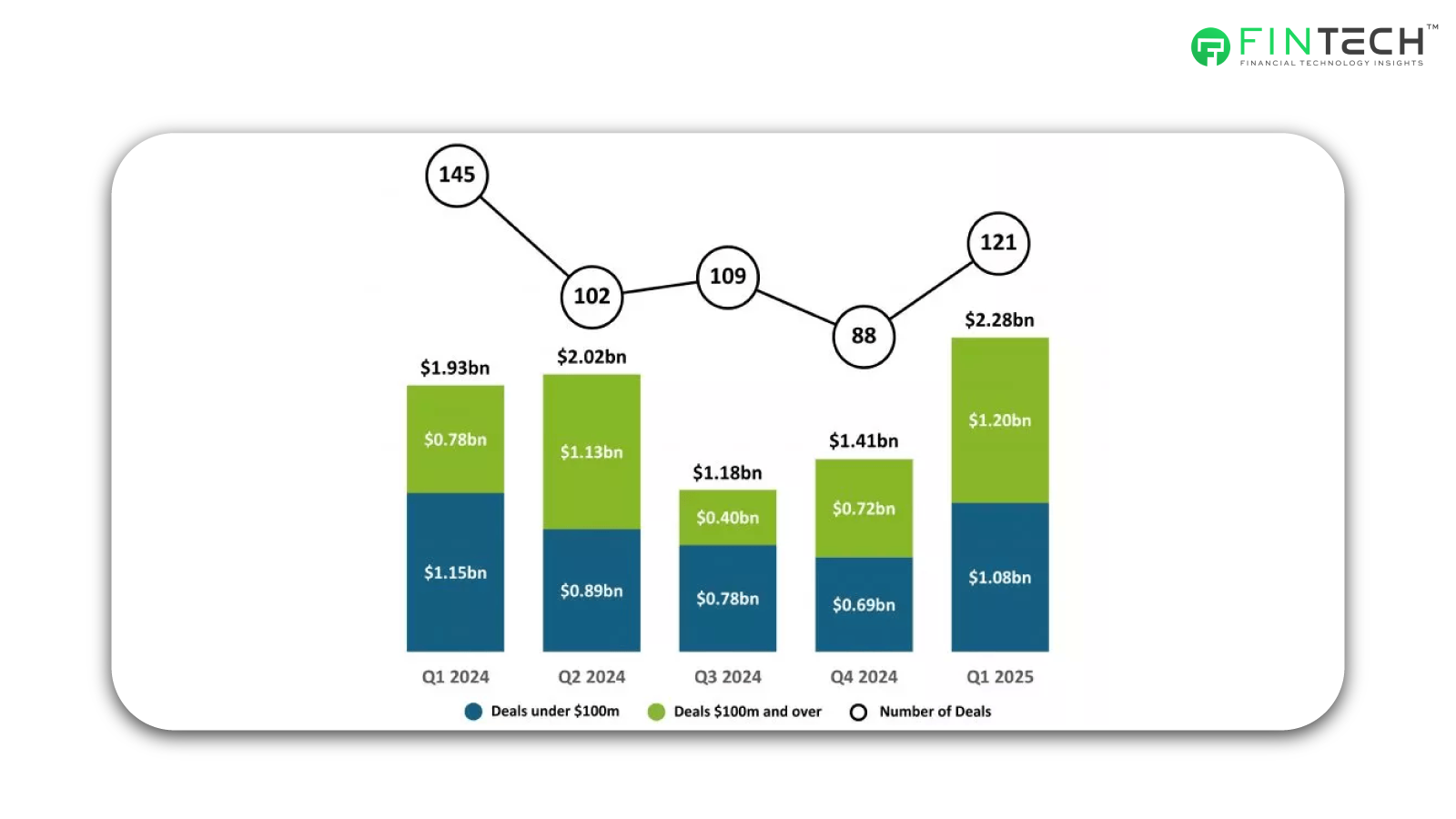
After twelve months of ups and downs in investment after investment, global RegTech funding rebounded significantly in Q1 2025 ($2.28 billion).
Resiliently fueled primarily by larger-than-average deals over $100 million, signifying renewed market confidence in technology-driven compliance solutions.
2024: A Season of Movement
The 2024 funding progress was not as strong in a bi-annual context. Q1 2024 displayed a stronger hunger (with a record $1.93 billion across 145 deals) with a reasonable mix of smaller and larger deals alongside industry bravado.
Q2 broke the record for the year at $2.02 billion (driven largely by bigger deals $1.13 billion). In turn, the second half of 2024 encountered a typical pullback from proximity to customer investment levels.
The total for Q4 2024 was $1.41 billion despite a comeback in deals over $100 million.
The funding levels were lower than Q1 2024’s record level. Q3 2024 totalled a lower funding value while maintaining total activity volume at $1.18 billion,
This illustrated both deal sizes and momentum changes to prove facilitator scenarios in the market.
Q1 2025: A Confident and Sturdy Rebound
The beginning of 2025 brought the trend completely in a different direction. Funding was up more than 60% from the previous quarter, to the highest level in five quarters.
High-value deals (above 100 million) generated 1.20 billion, more than half the total funding.
The number of deals went up from 88 in Q4 2024 to 121 in Q1 2025. This reflects that capital is flowing to both large-scale RegTech innovators as well as emerging developers.
This dual momentum means the market is not only excited about mega-rounds but also cultivating the next generation of compliance technology suppliers.
Implications for FinTech and Compliance Leaders
For FinTech players, the Q1 2025 data points to a competitive funding environment in which scalability and regulatory alignment matter most.
Compliance leaders should note that capital is now densely flowing into solutions that can plug and play into existing financial infrastructures and will quantify and reduce risk.
The total domination of $100M+ deals will likely accelerate consolidation, as well-funded RegTech firms purchase niche providers who can either expand their offering or roll out a new product.
In summary, Q1 2025’s significant growth was driven by one-off spikes; it’s about a market that’s aligning capital with a long-term shift in compliance.
Conclusion
The robust recovery in global funding in Q1 — evidenced by large deals and investor appetite. This signals a change from being niche solutions to being embedded as mainstream infrastructure within the financial services sector.
Advances in AI, real-time monitoring, and cross-border regulation help firms meet compliance obligations. These technologies also improve operational efficiency.
The message to financial institutions is clear: adopting RegTech is no longer a competitive advantage; it is now a regulatory and strategic requirement.
FAQs
1. What is the future outlook for RegTech in FinTech?
More integration with financial operations, evolving beyond compliance to a predictive type of resolution to compliance, probably more global regulatory harmonization, to increase financial efficiency in cross-border transactions.
2. What is powering the growth in RegTech funding in 2025?
There is are large amounts of regulatory pressure, no shortage of improving technologies, and a changing landscape of business models that operate and need to comply at scale, which have created the ability for both institutional investment and startup growth.
3. Can RegTech contribute to business growth?
Yes, the time and money spent on compliance can be directed toward innovation, new entrants to the market, etc.
4. How is RegTech different from conventional compliance?
While dealing with compliance typically relies on manual data, reporting, and dealing with regulation, RegTech solutions rely on data analysis, real-time automation, and a predictive type of compliance flexibility that allows firms to deal with risk exposure, compliance, and then, for example, report on time.
5. Why is RegTech relevant to FinTech companies in 2025?
The regulations are becoming more governable and global, with RegTech, it removes the challenge of regulatory compliance, lowers operational costs, and helps build comfort and trust with customers, while competition increases, for a FinTech company.
To participate in our interviews, please write to us at sudipto@intentamplify.com.