


A growing number of financial actions now happen without anyone opening a banking portal. Payroll runs and wages appear. Marketplaces release seller payouts when delivery confirmation hits.
Accounting software flags a tax liability and moves funds into a reserve account before a finance team logs in.
No one calls this banking. However, that is exactly what it is.
Financial activity is moving into software workflows, and the institutions that legally hold money are no longer the institutions deciding how it moves.
That is not innovation. It’s a structural relocation.
The Quiet Transfer of Financial Control
The odd part is that none of these systems set out to become financial institutions.
Payroll software was built to manage employees. Marketplaces were built to facilitate commerce. Accounting platforms were built for recordkeeping.
Yet each now determines timing, eligibility, and risk in financial transactions.
A bank still executes the payment. But it no longer decides when it should occur.
Historically, the financial institution sat at the moment of decision. If you wanted to pay a supplier, you would open a banking environment. If you needed credit, you approached a lender. The bank hosted the financial event.
Now the event originates upstream.
A shipment confirmation triggers settlement. An invoice triggers financing. Revenue volatility triggers automated cash allocation.
The bank provides regulated rails, whereas the platform provides financial judgment.
That is the power shift.
Finance Has Moved Into the Workflow Layer
Financial activity used to happen inside financial systems.
Today, it happens inside operational systems.
Businesses now pay suppliers through procurement software. Employees receive advances from payroll platforms. Merchants receive credit offers inside marketplaces. None of these interactions feels like banking to the user, yet each performs a traditional banking function.
The workflow now hosts the financial decision.
This matters because the organization controlling the workflow increasingly controls the customer relationship. The financial provider becomes an interchangeable infrastructure behind it.
Banks historically owned distribution. Platforms now own distribution.
Why Platforms Understand Risk Better
Financial institutions primarily evaluate financial records after an event occurs, while platforms monitor the activity that creates the financial event in the first place.
Banks evaluate transactions, and platforms observe behavior.
A bank sees a deposit, and a payroll system sees earned wages tied to actual hours worked, employment stability, and income consistency.
A bank sees a payment, and a commerce platform sees a completed sale, customer demand patterns, delivery confirmation, refund rates, and repeat purchasing behavior.
Risk assessment depends on context. Context exists where the activity originates, not where settlement occurs.
Platforms sit inside the operational workflow; they can measure performance trends over time rather than relying only on periodic financial statements or account balances.
Control Shifts From Accounts to Activity
Platforms are increasingly capable of underwriting, fraud detection, and liquidity timing because they observe the economic activity itself, not just the payment that follows it.
They see work completed, goods delivered, invoices generated, and revenue patterns forming in real time.
That gives them earlier and richer signals than a financial institution that only encounters the transaction at settlement.
This explains why lending is appearing in:
- Marketplaces
- Accounting software
- Payment processors
- Vertical SaaS systems
A marketplace can evaluate seller performance before revenue even reaches a bank account. Accounting platforms can detect cash-flow pressure from unpaid invoices. Payment processors can measure transaction velocity and refund behavior. Each system understands operational health, not just balances.
They are not expanding into finance. Finance is relocating into its data environment.
The financial decision now occurs at the moment of economic activity, while the bank primarily executes settlement and custody.
The institution still holds the money, but the platform increasingly determines when capital should move and under what conditions.
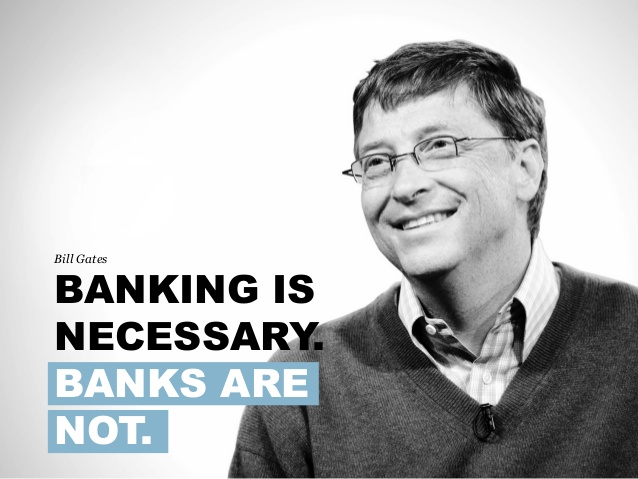
The New Role of Banks
Banks are not disappearing. But their position in the stack is moving.
Instead of operating primarily as service providers, they are becoming regulated infrastructure operators.
Source: Digitale Exzellenz
They provide custody of funds, access to payment networks, regulatory compliance, and liquidity. Another layer now handles customer experience and financial decision logic.
In practical terms, banks are moving down the technology stack.
This creates a paradox. Banks remain essential to the system while becoming less visible to the user.
AI Accelerates What Was Already Happening
Artificial intelligence did not start this transition. It accelerated it.
Financial operations follow structured patterns. Pay invoices. Detect anomalies. Allocate liquidity. Extend short-term credit.
One of the clearest signals that finance is dissolving into the digital economy comes from how embedded finance is reshaping the delivery and role of financial services. According to analysis by the World Economic Forum, embedded finance is not a niche experiment anymore — it is fundamentally redefining how financial products are accessed and delivered.
It “integrates payments, lending, insurance and other financial services into the apps and platforms people already use,” and is expected to reach around $7.2 trillion in global market size by 2030 as part of this transformation.
The integration of financial services directly into software platforms is expected to reshape distribution, with embedded financial services delivered inside everyday digital interactions.
Once software can evaluate cash flow and trigger actions, the interface stops mattering. The workflow becomes the operator.
This shift is already visible across major platforms.
Shopify and Amazon extend credit using seller performance data. Stripe and Square manage balances, cards, and liquidity inside software environments.
Toast evaluates restaurant health using POS activity, while payroll providers such as Gusto and ADP automatically initiate tax and wage payments.
In each case, the bank still holds funds, but the platform determines when and why money moves.
Commerce Platforms Deciding Financial Activity
Shopify
- Shopify Capital offers merchant loans automatically.
- The system analyzes store revenue, order volume, refund rates, and inventory turnover.
- Repayment is taken directly as a percentage of daily sales.
- A merchant does not apply to a bank; the platform determines eligibility.
Shopify demonstrates embedded finance in practice, operational performance determines credit eligibility, and repayment adjusts with daily sales.
Amazon
- Amazon Lending provides working capital to marketplace sellers.
- Eligibility is based on fulfillment performance, shipping reliability, and customer ratings.
- Sellers often receive offers before they seek financing.
Amazon sees real economic production, inventory movement, and demand. A traditional lender only sees deposits and withdrawals.
Payment Companies Becoming Financial Operators
Stripe
- Stripe Treasury enables platforms to create accounts, hold balances, and issue cards.
- Stripe Capital provides funding using payment flow data.
- Businesses manage money inside software, not a bank portal.
Stripe does not just process payments anymore. It orchestrates cash management and liquidity timing while partner banks handle custody and regulation.
Square, Inc.
- Square offers instant payouts to merchants.
- Square Loans are based on card transaction velocity.
- Repayment happens automatically from incoming transactions.
The underwriting signal is transaction behavior, not a credit application.
Vertical SaaS platforms underwriting risk
Toast, Inc.
(restaurant management software)
- Provides financing to restaurants using POS data.
- Evaluates table turnover, average ticket size, and daily revenue patterns.
Toast understands a restaurant’s health before any money reaches a bank account.
Mindbody
(fitness and wellness business software)
- Offers capital advances to gyms and studios.
- Uses booking frequency, class attendance, and membership retention as risk indicators.
These are operational metrics, not financial records.
Payroll Platforms Controlling Liquidity Timing
Gusto
- Provides employee cash-flow tools and wage access.
- Automatically moves funds for payroll tax obligations.
- Determines when money must leave an employer account.
ADP
- Handles payroll, compliance withholding, and tax payments automatically.
- The finance team does not initiate the payment event anymore.
- The payroll system triggers the financial movement.
The financial decision happens at the moment work is completed, not when a finance department opens a bank portal.
Marketplaces Controlling Settlement
Uber
- Drivers receive instant payouts after trips.
- Earnings access depends on completed rides and performance behavior.
Airbnb
- Host payouts trigger automatically after check-in or stay completion.
- Payment timing depends on booking events, not bank instructions.
Economic activity triggers financial settlement. The bank only executes the transfer.
The Next Competitive Battlefield
Competition in finance used to center on price and interface. Interest rates, branch coverage, and app usability.
The next competition will center on control. Control of identity, behavioral data, and transaction initiation.
The organization that holds these controls the financial relationship, regardless of who legally holds the account.
This is why payroll providers, commerce platforms, and enterprise software firms are becoming central financial actors without presenting themselves as banks.
Financial Giants Won’t Look Like Banks
The next major financial institutions may not call themselves financial institutions.
Banks increasingly supply custody, liquidity, and compliance. Platforms increasingly supply decision-making. One provides the regulated rails. The other decides when those rails are used.
This is why the competitive landscape is shifting away from interest rates and user interface design. The advantage now belongs to whoever controls the moment a financial action is triggered.
If a system can see the economic event in real time, a sale, a shipment, or earned wages, it can initiate payment, extend credit, or restrict risk before a customer even considers opening a banking app.
Customers once chose a bank and then performed economic activity. Now, economic activity occurs first, and a financial action follows automatically.
So the defining question for the next decade is no longer which bank a customer selects. It is the system that is trusted to act on their behalf.
FAQs
1. Are banks becoming obsolete because of fintech?
No. Banks are not disappearing. Their role is shifting. They increasingly provide regulated infrastructure such as custody of funds, settlement access, and compliance oversight, while platforms and software systems manage the customer experience and financial decision-making.
2. What is embedded finance, and why does it matter to non-financial companies?
Embedded finance allows companies to offer payments, lending, or financial tools directly inside their products. It matters because businesses can monetize user activity, improve retention, and control the customer relationship without becoming a licensed bank.
3. How will AI change financial services operations?
AI will automate routine financial decisions, including fraud detection, underwriting signals, cash-flow forecasting, and payment scheduling. The biggest impact is operational. Finance teams will supervise systems rather than manually approve transactions.
4. Who owns the customer relationship in the future of finance?
The organization controlling the workflow owns the relationship. If customers interact with payroll software, marketplaces, or accounting platforms to manage money, those platforms become the primary financial touchpoint even when a bank holds the account.
5. What should financial institutions prioritize to stay competitive?
Institutions need strong APIs, real-time data access, and partnerships with platforms. Competitive advantage is moving from product features and interest rates toward integration, identity verification, and decision intelligence capabilities.
To participate in upcoming interviews, please contact us at info@intentamplify.com