

Modern businesses now move value across APIs, marketplaces, contractor networks, and global developer ecosystems at software speed. The payment rail became part of the application stack. When that happens, payments stop being a financial control and start being a security surface. However, stablecoins quietly solved a problem banks still struggle with. Always-on settlement.
The numbers explain why executives are paying attention. Visa’s on-chain analytics team estimated that stablecoins settled over $10 trillion in transaction volume in 2023, rivaling major card networks in throughput, though with very different usage patterns.
Payments used to be messaging between banks. Stablecoins are programmable bearer assets. Security teams must treat them the way they treat identity tokens, API keys, or session credentials. Because operationally, that is what they behave like.
For CISOs and cybertech leaders, the shift is uncomfortable. You cannot firewall a blockchain. You cannot reverse a transaction. You cannot rely on a chargeback. And yet business stakeholders increasingly see stablecoins as the only mechanism capable of real-time cross-border settlement.
What Stablecoins Changed in the Payment Architecture
The typical explanation of stablecoins is wrong. They are not “digital dollars.” They are programmable settlement guarantees.
Traditional payment rails separate three layers:
- Authorization
- Clearing
- Settlement
“Tokenized deposits allow for programmability within the existing banking framework, avoiding the fragmentation of liquidity inherent to non-bank stablecoins.”
— MAS Project Guardian Technical White Paper (2024)
Programmable Money Changes the Threat Model
Card networks authorize instantly but settle in batches. Wires settle but are slow and operationally expensive. ACH clears cheaply but introduces risk windows. Every financial control framework in enterprise cybersecurity evolved around those delays.
Stablecoins collapse those layers into one event. When a transaction finalizes on-chain, authorization, clearing, and settlement happen simultaneously.
According to the Federal Reserve Bank of New York’s 2024 staff report on tokenized payments infrastructure, stablecoins reduce settlement latency from days to minutes but remove intermediary verification checkpoints that historically functioned as fraud and compliance buffers.
In other words, banks were not only payment processors. They were security middleware. Stablecoins remove middleware. The fintech community views that as efficiency. Security leaders should view it as exposure.
When Developers Control Settlement
Consider a SaaS platform paying global contractors. With traditional rails, payment fraud often manifests after reconciliation. With stablecoins, compromise manifests instantly and irreversibly. Incident response changes from recovery to containment.
There is a second architectural shift most executives underestimate. Stablecoins function as application-layer money. Developers can embed payments directly into workflows without a financial institution API acting as the primary control plane.
Stripe’s developer and platform research shows software platforms are embedding treasury, payouts, and settlement capabilities directly into their applications, especially marketplaces operating internationally.
This is why the stablecoin conversation moved from treasury to security. Payments became programmable infrastructure. And programmable infrastructure creates new attack paths.
Adoption Is Not Retail Speculation: It Is Operational Demand
Public perception still associates stablecoins with cryptocurrency trading. Data shows something different.
Chainalysis observed that stablecoins are heavily used in regions with volatile banking systems, but enterprise adoption is emerging in a different pattern: B2B settlement, liquidity routing, and cross-border payroll.
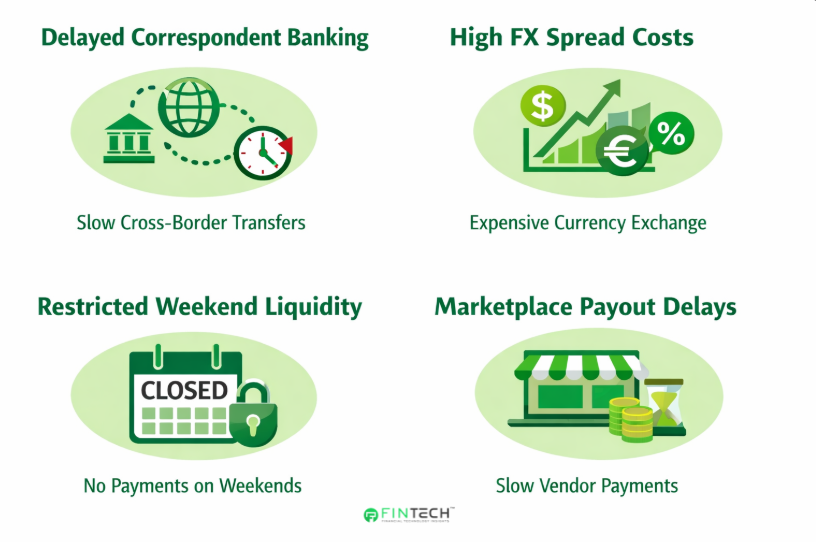
Fintech companies are not experimenting. They are solving specific operational problems:
- Delayed correspondent banking.
- High FX spread costs
- Restricted weekend liquidity.
- Marketplace payout delays.
Why this matters to cyber leaders:
Cross-border settlement used to pass through multiple regulated intermediaries. Each intermediary acted as a monitoring checkpoint. Now, a single wallet compromise can move value across jurisdictions in seconds.
Fireblocks, a digital asset custody infrastructure provider, reported that institutional stablecoin transfers grew significantly among payment companies and fintech platforms rather than trading firms in 2024. That shift is critical. Trading systems operate in controlled environments. Operational platforms interact with users.
The first wave of crypto risk was exchange hacking. The second wave is operational fraud. Marketplace escrow manipulation, payroll diversion, API wallet abuse. These resemble classic business email compromise, except that the settlement is immediate and recovery options are minimal.
For CISOs, the core issue is simple. Stablecoin adoption is not a financial trend. It is a workflow change.
Security Risk Model
Why stablecoins behave more like identity systems than payment systems
Stablecoins are closer to OAuth tokens than bank transfers.
Control over a private key equals control over the funds. No secondary authentication, no issuer override, no dispute arbitration. Ownership is cryptographic, not legal.
The Cybersecurity and Infrastructure Security Agency (CISA) warned in 2024 that software supply-chain compromises increasingly target credential stores and API access to enable lateral movement (CISA Secure by Design Alert, 2024). Replace “credentials” with “wallet keys,” and the threat model is nearly identical.
Key compromise becomes the primary threat vector.
Common enterprise assumptions fail here:
- Traditional fraud detection relies on behavioral monitoring across accounts.
- Stablecoins operate across addresses, not accounts.
- Stablecoin transactions are final.
- Traditional payment fraud depends on impersonation.
- Stablecoin theft depends on key exposure.
According to TRM Labs’ 2025 illicit finance report, wallet compromises and social engineering attacks increasingly target businesses rather than individuals, particularly companies handling customer funds.
Treat Stablecoins Like Credentials
Security teams need to classify stablecoins as:
- Critical cryptographic assets
- Production infrastructure components
- Privileged authentication systems
This classification changes governance. Wallet storage architecture now belongs in threat modeling, incident response planning, and identity access management reviews.
Many fintech organizations deploying stablecoin payouts still store operational wallet keys in environments that would never pass an internal secrets-management audit.
Compliance and Regulatory Pressure
Why the risk is now executive-level
Regulators no longer treat stablecoins as experimental.
In 2024, the U.S. Treasury’s Financial Stability Oversight Council warned that stablecoin arrangements could pose systemic risks without appropriate oversight and recommended federal regulatory frameworks for issuers and custodians.
Notice the language. Not consumer protection. Operational resilience.
For CISOs, that signals something important. Stablecoin risk will be evaluated under the same expectations applied to payment processors and systemically important financial institutions: availability, integrity, and custody security.
This introduces a new accountability gap inside organizations.
Treasury teams adopt stablecoins for efficiency. Engineering teams integrate them for programmability. But regulators will look to security leadership for operational control failures.
And the legal exposure is non-trivial. Unlike traditional payment fraud, blockchain transactions leave public forensic evidence. Investigators can trace flows, attribute negligence, and evaluate whether proper controls existed.
Cybersecurity leaders are therefore moving from an advisory role to a control owner.
Strategic Security Architecture
What mature fintechs are actually implementing.
The industry is converging around a pattern, though it is rarely documented publicly.
- Segmented wallet architecture.
- Policy-based transaction approval.
- Hardware-backed key custody.
- Continuous blockchain monitoring.
Multi-party computation (MPC) custody systems are replacing single-key wallets in enterprise deployments because they distribute signing authority across independent environments. This prevents a single compromised host from authorizing transfers.
Another emerging control is blockchain intelligence monitoring. Firms now monitor wallet interactions the way they monitor network traffic. Suspicious address interaction, anomalous transaction timing, and smart contract behavior become SIEM inputs.
Elliptic’s 2024 compliance research highlights how institutions are integrating blockchain risk intelligence directly into transaction monitoring and fraud analytics systems, rather than treating on-chain activity as a post-settlement reconciliation exercise.
The implication is subtle but important. Stablecoins are entering the SOC.
Trade-offs Leadership Must Confront
Stablecoins provide real advantages. They also introduce risks that banks historically absorbed.
Benefits:
- instant settlement
- global liquidity
- programmable payouts
- reduced reconciliation overhead
Costs:
- irreversible loss events
- key management complexity
- regulatory uncertainty
- new insider threat vectors
There is also a contradiction that executives often miss. Stablecoins reduce counterparty risk while increasing operational risk.
When you remove intermediaries, you remove both friction and protection.
Federal Reserve payments research shows that real-time payment systems shift risk management toward the transaction initiation point, requiring stronger controls at the endpoint rather than reliance on downstream clearing and review processes.
Stablecoins are the extreme version of that principle.
The Incident You Cannot Roll Back
Most executives still imagine a payment incident as a finance problem. A fraudulent wire. A chargeback dispute. An accounting reconciliation exercise. A stablecoin incident is closer to an identity breach.
What a Stablecoin Breach Looks Like
Picture a mid-size U.S. SaaS marketplace. The platform pays international contractors weekly. To remove cross-border delays, the company implements stablecoin payouts. The wallet infrastructure sits behind an internal service account used by a payout microservice.
Access is restricted. Logging exists. The deployment passes a typical application security review.
Then a routine event happens. A developer workstation is compromised through a package dependency attack. The attacker does not target the wallet directly. They target the CI/CD pipeline credentials.
From there, the path is short. The attacker injects a minor configuration change into a payout service. Not code that triggers alarms. Just a modification to an environment variable that routes a small percentage of payouts to a different address. It runs for six hours.
No fraud alert fires. The transactions look legitimate. The approvals are valid. The blockchain confirms them.
Funds are gone.
Blockchain incident response firms consistently report that many organizational crypto losses originate from key exposure, infrastructure compromise, or workflow manipulation rather than cryptographic failure.
Here is the operational difference security leaders must internalize.
In traditional payment fraud:
- Banks provide detection layers.
- Transfers can sometimes be frozen.
- Investigation occurs before final settlement.
In a stablecoin breach:
- The system itself authorizes the theft.
- Settlement occurs immediately.
- An investigation happens after a loss.
The blockchain becomes the audit trail, not the safeguard.
Why Standard Controls Fail
Many organizations secure wallet keys but ignore transaction intent. That is the mistake.
Attackers rarely steal a cold-storage key from a vault. They manipulate a trusted workflow. Compromised approval APIs, altered payout logic, or social engineering of operations staff are far more common because they bypass cryptography entirely.
Cybersecurity teams recognize this pattern. It mirrors cloud breaches.
The 2024 Verizon Data Breach Investigations Report shows the majority of breaches involve credential misuse or authorized access abuse rather than technical exploitation. Stablecoin systems amplify this problem because authorized access directly equals financial settlement.
If a compromised service account can sign a transaction, the attacker does not need persistence. They need minutes.
What Has to Change
Organizations adopting stablecoin settlement must start applying financial-grade controls to software behavior.
Controls that actually matter:
Transaction policy enforcement
Define what a valid payment looks like. Destination allowlists, amount thresholds, and time-of-day restrictions. Not just authentication.
Out-of-band approval
Large or anomalous transactions must require a second control channel independent of the application stack.
Continuous blockchain monitoring
Treat wallet activity like network telemetry. SIEM and SOAR platforms should ingest on-chain activity the same way they ingest authentication logs.
Operational segregation
The service that creates a transaction should never be the same environment that authorizes it.
These are not crypto-specific controls. They are adaptations of high-assurance access governance.
The Real Governance Shift
Stablecoins blur the historical boundary between treasury operations and privileged system access. The wallet is no longer a financial account. It is a production credential with monetary authority.
That changes incident response categorization. A stolen database leaks data. A stolen key moves capital. Both originate from the same root cause. Control over a trusted system identity.
Once leadership sees that connection, stablecoin security stops looking like a niche blockchain issue and starts looking like a familiar enterprise risk. Access control tied directly to material business impact.
That is why the next breach many companies face will not be recorded as a “crypto incident.” It will be recorded as a security incident that happened to settle money.
Why This Matters Beyond Fintech
From a security standpoint, stablecoins are not really competing with banks. They are competing with latency.
Every organization that manages distributed contractors, digital marketplaces, or automated transactions eventually runs into the same operational friction.
Cross-border settlement is slow. Reconciliation is manual. Weekends break workflows. Product teams start searching for a real-time alternative. Stablecoins appear less as a crypto decision and more as an operational fix.
At that moment, the ownership quietly shifts. The project may originate in finance or product, but the risk lies in security. By the time security formally engages, value is already moving.
What stablecoins actually change is not the currency. It is the trust boundary. Payments used to cross institutional perimeters controlled by banks.
Now they cross application perimeters controlled by software. That makes the wallet environment part of the production security architecture, not a finance workflow.
FAQs
1. Are stablecoins safe for enterprise payments?
They can be, but only with institutional custody controls. Stablecoins remove bank intermediaries, so security shifts to key management. Enterprises need hardware-backed custody, multi-party approval workflows, and transaction monitoring. Without those controls, a wallet compromise functions like a root credential breach, and funds are not recoverable.
2. Why are fintech companies adopting stablecoins instead of traditional payment rails?
Stablecoins enable near-instant global settlement and 24/7 liquidity. Traditional rails rely on correspondent banks, cut-off times, and reconciliation delays. For marketplaces and global payroll platforms, real-time settlement reduces operational overhead and working-capital lockup.
3. What cybersecurity risks do stablecoins introduce?
The primary risk is private-key compromise. Unlike card fraud, stablecoin transfers cannot be reversed. Attack vectors include wallet credential theft, API abuse, social engineering of payout approvals, and insider access to signing infrastructure. The threat model resembles identity-and-access management more than payment fraud.
4. Do stablecoins create regulatory or compliance exposure for U.S. companies?
Yes. U.S. regulators increasingly treat stablecoin custody, transaction monitoring, and operational resilience as financial-infrastructure responsibilities. Companies handling customer funds may face AML, sanctions screening, and safeguarding expectations similar to those of payment processors.
5. When should a security team get involved in a stablecoin project?
Before integration begins. Once a wallet is connected to production systems or customer payouts, it becomes a privileged asset. Security teams should define custody architecture, approval policies, monitoring, and incident response procedures during design, not after deployment.
To participate in upcoming interviews, please contact us at info@intentamplify.com